Case Studies > General Simulation
Multi-Family Residence Analysis Improves on NECB Requirements by 50%
| About | Meet stringent energy efficiency and greenhouse gas emission reduction requirements for a multifamily building in Calgary. | 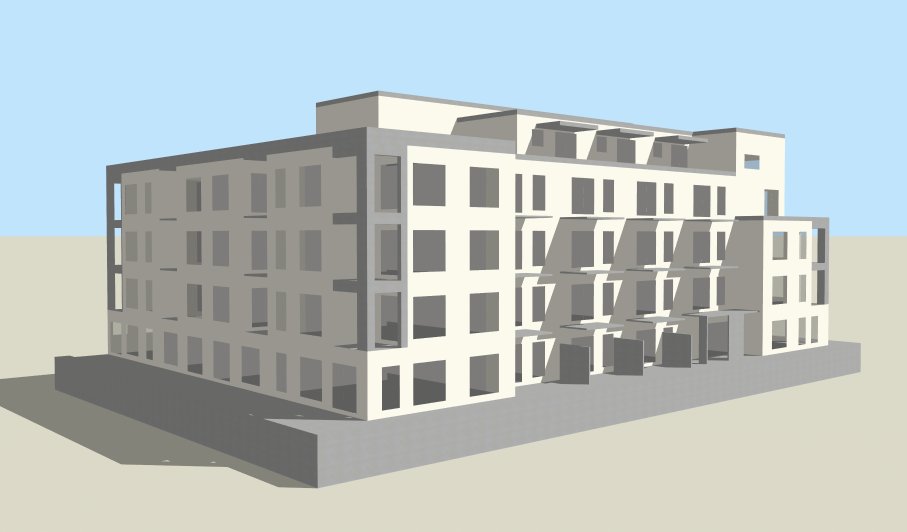 |
| By | Paul Caicedo, EMBE Consulting Engineers | |
| Location | Calgary, Alberta, Canada | |
| Category | NECB, multi-family building | |
| Highlights |
|
Abstract
The project aimed to meet stringent energy efficiency and greenhouse gas emission reduction requirements for a multifamily building in Calgary, Alberta, Canada. Through the Green Buildings Priority Stream – Entry Pathway #1 program, the objective was to achieve 25% less energy consumption and emit 50% fewer GHG emissions than the National Energy Code for Buildings (NECB) 2017. By utilizing DesignBuilder, the team successfully optimized building performance and implemented energy conservation measures to meet these ambitious goals.
Introduction
In response to increasing environmental concerns and regulatory demands, the challenge was to design and construct a multifamily building in Calgary that surpassed standard energy efficiency benchmarks. The project faced the specific challenge of meeting the stringent requirements set out by the Green Buildings Priority Stream – Entry Pathway #1 program, which demanded significant reductions in energy consumption and GHG emissions compared to NECB 2017 standards. DesignBuilder helped to address this challenge by providing comprehensive energy modelling and simulation capabilities.
Methodology
DesignBuilder played a central role in the project's methodology by enabling the creation of a detailed 3D model of the multifamily building. This model incorporated key building components such as exterior walls, windows, plug loads, lighting fixtures, and heating systems, all configured to meet or exceed the specified energy efficiency standards.
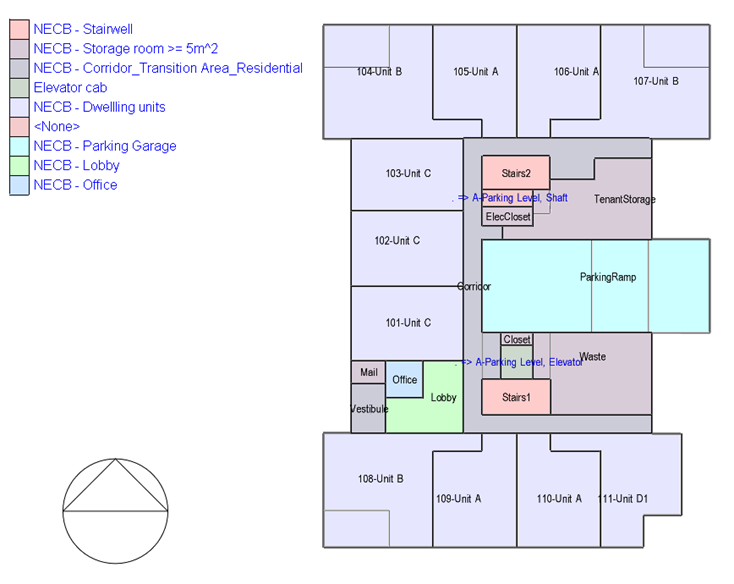 Floor Plan Layout for Level 1
Heating and domestic hot water systems were carefully designed using DesignBuilder's simulation capabilities, with a focus on maximizing efficiency while meeting occupants' comfort requirements. This involved specifying radiant floor heating supplied by condensing boilers for dwelling units and a gas-fired water heater with 95% heating efficiency for domestic hot water, along with low-flow fixtures to minimize water consumption.
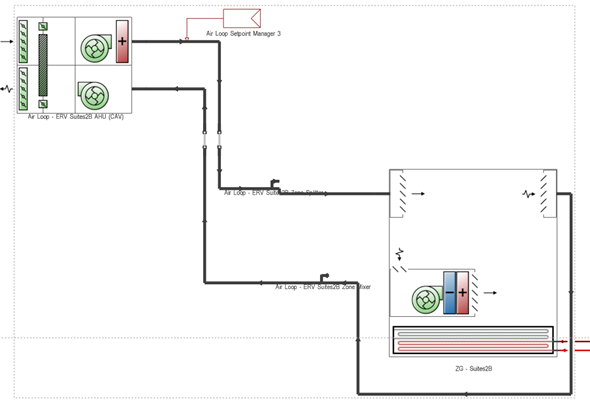 Schematic diagram illustrating the underfloor heating and mechanical ventilation system used in a portion of the building
Parametric Analysis
The inputs for the initial scenario were exterior walls to 2"x6" wood studs with R-22 batt insulation, triple-pane windows with Low-E film, Energy Star appliances for plug loads, and LED lighting throughout the building. The parametric analysis was carried out to study the best combination of envelope variables that allows achieving savings of more than 25% and 50% in energy and GHG, respectively.
The variables to be analyzed are described below:
- Window Wall Ratio:
- WWR: 23.9% (initial design)
- WWR: 22.9%
- Exterior walls:
- 6” batt insulation (6” wood studs, initial design)
- 6” batt insulation (6” wood studs) and exterior insulation (R-3, zip system insulated)
- 8” batt insulation (8” wood studs)
- Roof:
- Effective R-value: R-50 (initial design)
- Effective R-value: R-60
- Windows:
- Triple panel and vinyl frame: USI-1.20 / SHGC-0.40 (initial design)
- Triple panel and PVC frame: USI-0.852 / SHGC-0.49 (All Weather Windows specs)
- Triple panel and fiberglass frame: USI-0.970 / SHGC-0.23 (Accurate Dorwin specs)
The savings achieved by combining each variable are presented in the graph and table below.
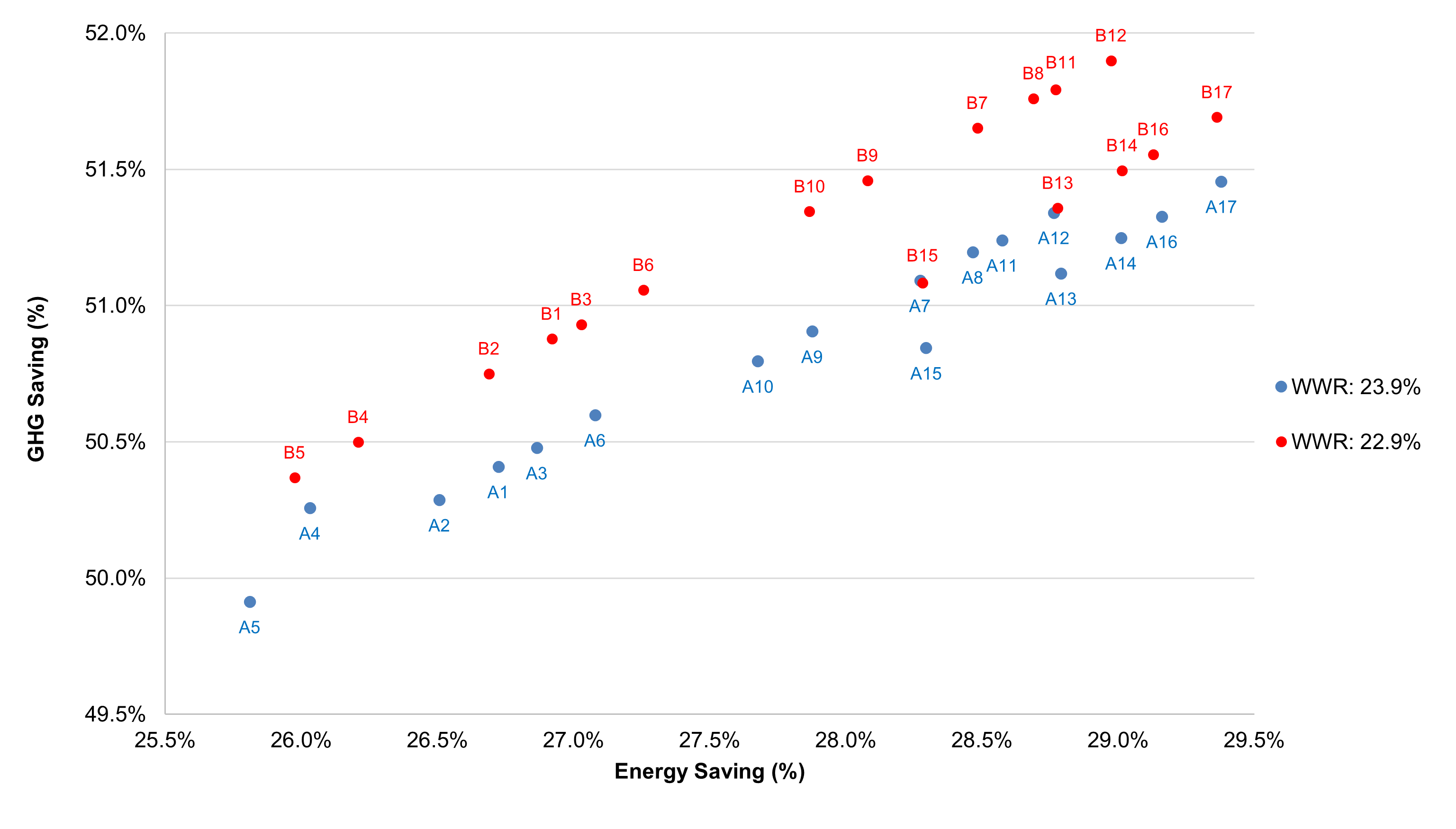
| Point | WWR | Wall | Roof | Glazing | Energy Saving | GHG Saving |
|---|---|---|---|---|---|---|
| A1 | 23.9 | 6" batt insul.+ R-3 exterior insul. | R-60 | Triple pane / Vinyl frame | 26.7% | 50.4% |
| A2 | 23.9 | 6" batt insul.+ R-3 exterior insul. | R-50 | Triple pane / Vinyl frame | 26.5% | 50.3% |
| A3 | 23.9 | 8" batt insulation | R-50 | Triple pane / Vinyl frame | 26.9% | 50.5% |
| A4 | 23.9 | 6" batt insulation | R-60 | Triple pane / Vinyl frame | 26.0% | 50.3% |
| A5 | 23.9 | 6" batt insulation | R-50 | Triple pane / Vinyl frame | 25.8% | 49.9% |
| A6 | 23.9 | 8" batt insulation | R-60 | Triple pane / Vinyl frame | 27.1% | 50.6% |
| A7 | 23.9 | 6" batt insul.+ R-3 exterior insul. | R-50 | Triple pane / PVC frame | 28.3% | 51.1% |
| A8 | 23.9 | 6" batt insul.+ R-3 exterior insul. | R-60 | Triple pane / PVC frame | 28.5% | 51.2% |
| A9 | 23.9 | 6" batt insulation | R-60 | Triple pane / PVC frame | 27.9% | 50.9% |
| A10 | 23.9 | 6" batt insulation | R-50 | Triple pane / PVC frame | 27.7% | 50.8% |
| A11 | 23.9 | 8" batt insulation | R-50 | Triple pane / PVC frame | 28.6% | 51.2% |
| A12 | 23.9 | 8" batt insulation | R-60 | Triple pane / PVC frame | 28.8% | 51.3% |
| A13 | 23.9 | 6" batt insul.+ R-3 exterior insul. | R-50 | Triple pane / Fiberglass frame | 28.8% | 51.1% |
| A14 | 23.9 | 6" batt insul.+ R-3 exterior insul. | R-60 | Triple pane / Fiberglass frame | 29.0% | 51.2% |
| A15 | 23.9 | 6" batt insulation | R-60 | Triple pane / Fiberglass frame | 28.3% | 50.8% |
| A16 | 23.9 | 8" batt insulation | R-50 | Triple pane / Fiberglass frame | 29.2% | 51.3% |
| A17 | 23.9 | 8" batt insulation | R-60 | Triple pane / Fiberglass frame | 29.4% | 51.5% |
| B1 | 22.9 | 6" batt insul.+ R-3 exterior insul. | R-60 | Triple pane / Vinyl frame | 26.9% | 50.9% |
| B2 | 22.9 | 6" batt insul.+ R-3 exterior insul. | R-50 | Triple pane / Vinyl frame | 26.7% | 50.8% |
| B3 | 22.9 | 8" batt insulation | R-50 | Triple pane / Vinyl frame | 27.0% | 50.9% |
| B4 | 22.9 | 6" batt insulation | R-60 | Triple pane / Vinyl frame | 26.2% | 50.5% |
| B5 | 22.9 | 6" batt insulation | R-50 | Triple pane / Vinyl frame | 26.0% | 50.4% |
| B6 | 22.9 | 8" batt insulation | R-60 | Triple pane / Vinyl frame | 27.3% | 51.1% |
| B7 | 22.9 | 6" batt insul.+ R-3 exterior insul. | R-50 | Triple pane / PVC frame | 28.5% | 51.7% |
| B8 | 22.9 | 6" batt insul.+ R-3 exterior insul. | R-60 | Triple pane / PVC frame | 28.7% | 51.8% |
| B9 | 22.9 | 6" batt insulation | R-60 | Triple pane / PVC frame | 28.1% | 51.5% |
| B10 | 22.9 | 6" batt insulation | R-50 | Triple pane / PVC frame | 27.9% | 51.3% |
| B11 | 22.9 | 8" batt insulation | R-50 | Triple pane / PVC frame | 28.8% | 51.8% |
| B12 | 22.9 | 8" batt insulation | R-60 | Triple pane / PVC frame | 29.0% | 51.9% |
| B13 | 22.9 | 6" batt insul.+ R-3 exterior insul. | R-50 | Triple pane / Fiberglass frame | 28.8% | 51.4% |
| B14 | 22.9 | 6" batt insul.+ R-3 exterior insul. | R-60 | Triple pane / Fiberglass frame | 29.0% | 51.5% |
| B15 | 22.9 | 6" batt insulation | R-60 | Triple pane / Fiberglass frame | 28.3% | 51.1% |
| B16 | 22.9 | 8" batt insulation | R-50 | Triple pane / Fiberglass frame | 29.1% | 51.6% |
| B17 | 22.9 | 8" batt insulation | R-60 | Triple pane / Fiberglass frame | 29.4% | 51.7% |
Conclusion
Through the strategic utilization of DesignBuilder, the project successfully achieved its objectives of exceeding energy efficiency and GHG emission reduction targets for the multifamily building in Calgary. By implementing a combination of advanced building envelope design, energy-efficient systems, and optimized operational strategies, the building surpassed the requirements set forth by the Green Buildings Priority Stream – Entry Pathway #1 program.
The successful completion of this project highlights DesignBuilder's role as an important tool in advancing sustainable building practices, ensuring that multifamily buildings not only meet but also exceed energy efficiency standards.
The Table below shows the breakdown of final energy use for the proposed and reference buildings, based on the summary of inputs described in the previous section.
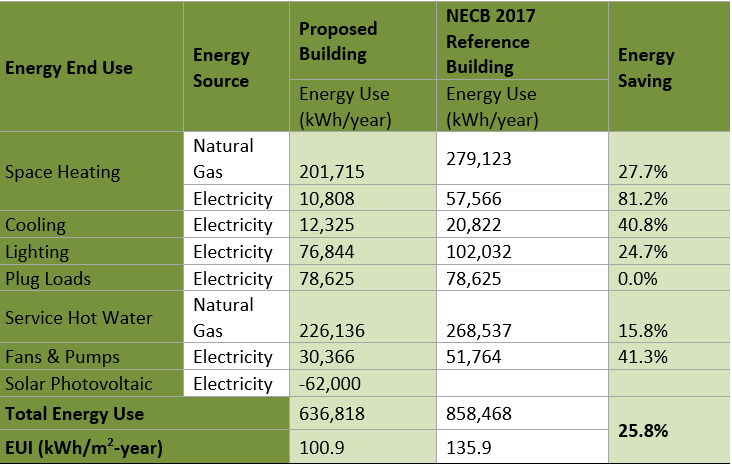
Energy Performance Summary
 |
About the authorPaul Caicedo, P.Eng., BEMP, LEED® Green Associate
|